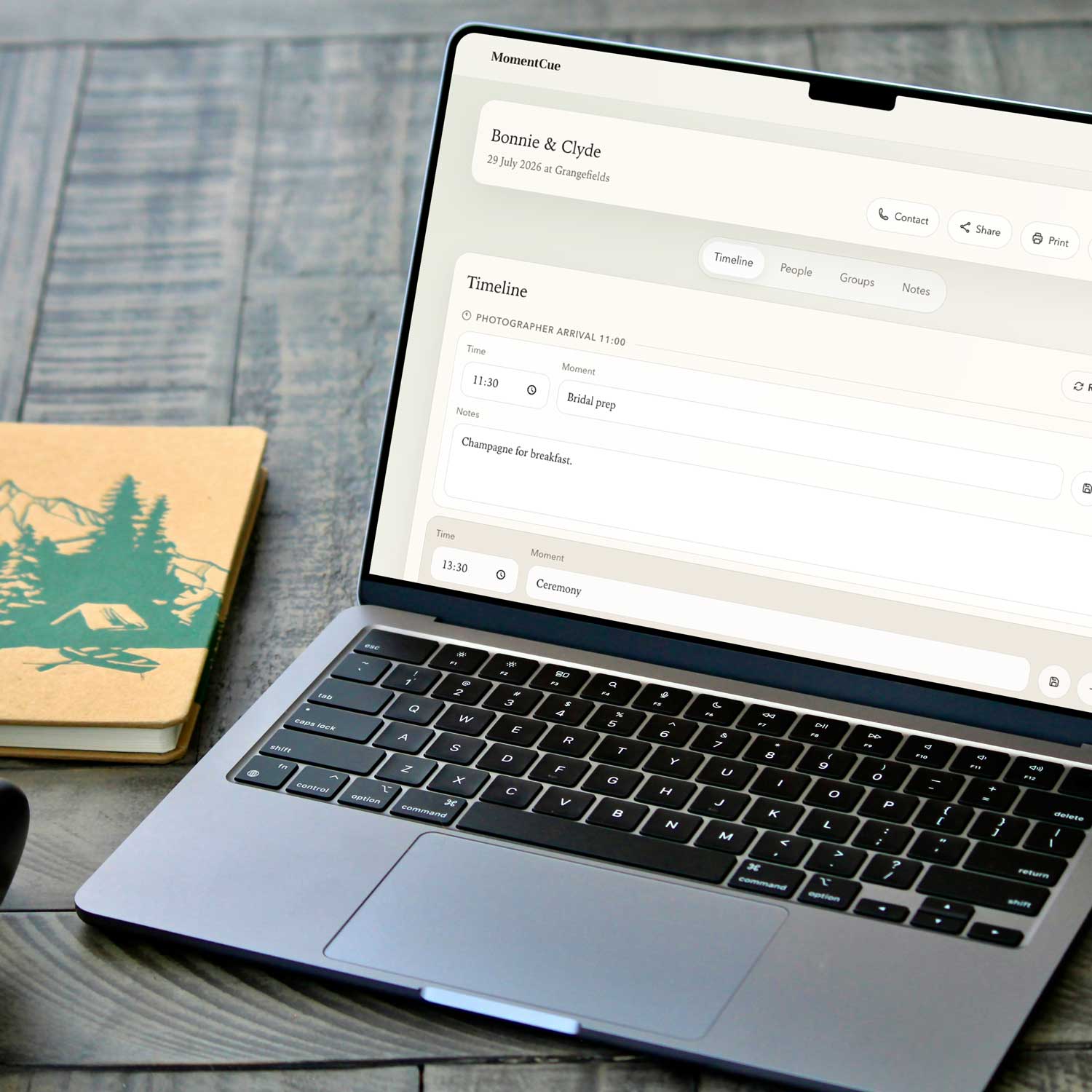
Example full-day photography timeline
| Time | Moment | Photographer planning note |
|---|---|---|
| 11:30 | Photographer arrives | Venue access and room check |
| 11:45 | Details and preparation | Hair and makeup finishing by 12:30 |
| 13:00 | Getting dressed | Key people present and room cleared |
| 13:30 | Travel to ceremony | Parking confirmed; 15-minute buffer |
| 14:00 | Ceremony | No flash; photographer movement restricted |
| 14:45 | Confetti and congratulations | Helpers begin gathering first family group |
| 15:05 | Family photographs | Eight named groups; wet-weather location reserved |
| 15:35 | Couple portraits | Twenty minutes plus walk back |
| 16:00 | Reception entrance | Fixed venue time |
| 16:30 | Meal | Photographer break after room details |
| 18:30 | Speeches | Order and lectern position confirmed |
| 19:45 | Golden-hour portraits | Ten-minute optional window |
| 20:30 | First dance | Lighting test before guests enter |
Use the structure, not the exact times. Every venue, culture, season and coverage package changes the day.
Start with fixed anchors
Enter events that cannot easily move: ceremony start, venue access, meal service, speeches controlled by catering, sunset, and your contracted arrival and departure. Then work outward. If the ceremony begins at 14:00, determine when you must leave preparations, when dressing needs to finish, and how much buffer protects against traffic or parking.
Label provisional times. A schedule becomes dangerous when an estimate looks as authoritative as a confirmed venue time. Record the source of important timings—couple, planner, venue or your own recommendation—and revisit the assumptions during the final review.
Write dependencies beside the time
‘Getting dressed at 13:00’ depends on hair and makeup finishing, the room being ready, the outfit and accessories being present, and any key people returning from their own preparations. ‘Family photographs at 15:05’ depends on the ceremony ending, confetti finishing, the location being available, and helpers gathering named people.
You do not need a project-management chart on the wedding day. You do need the one sentence that prevents a surprise. Put operational notes beside the relevant moment, not in a separate document nobody opens. Highlight dependencies that require action before the wedding.
Protect portrait time and transitions
Separate family groups from couple portraits even when they happen consecutively. Their risks are different. Family time depends on gathering and group count; couple time depends on travel, light, privacy and how quickly the couple can disengage from guests.
Add the walk to and from portrait locations. A fifteen-minute sunset session at a viewpoint ten minutes away is a thirty-five-minute commitment. Include time to reset equipment, coordinate with video, and return before a fixed reception event. A small portrait buffer is easier to surrender than a promised photograph is to recover.
Let questionnaire answers change the timeline
A timeline template is only a starting structure. The questionnaire supplies the conditions. A second preparation address changes travel. A request for private vows creates a new fixed moment. A grandparent leaving early moves a group forward. A ceremony restriction may require arriving sooner to agree a position. A surprise performance affects lighting and coverage responsibilities.
Review the answers against the schedule rather than reading them in isolation. When one answer changes a time, look downstream. Moving the family photographs may alter the couple session, room-details coverage and reception entrance. Keep one master timeline so corrections do not diverge across a CRM, PDF and phone note.
Make the final version usable on the day
The working timeline must be scannable in difficult conditions. Use short titles, consistent time formatting and only the notes that affect action. Keep phone numbers, addresses and private context attached but visually secondary. Mark completed moments where helpful and make the next item obvious.
Carry an offline or printable backup. Signal can disappear and batteries fail. Share the appropriate version with a second photographer or assistant, but keep sensitive couple notes private. Lock the approved plan while retaining a simple method for recording genuine last-minute changes.
Adapt the template for weather, travel and multi-day events
Create a wet-weather branch before the forecast becomes urgent. Record the alternative portrait location, walking time, capacity and any permission required. Do not build a completely separate schedule unless the timings genuinely change; keep one plan with clear conditional notes so the team cannot open the wrong version.
For several venues, give every travel block a departure time, expected duration, parking instruction and buffer. If the couple travels separately, state who covers each arrival. For destination or multi-day celebrations, create one high-level coverage plan and a focused timeline for each day. Repeat critical contacts and locations where they are needed rather than forcing the photographer to search another document.
Cultural and religious ceremonies may contain fixed sequences that are unfamiliar to a second photographer or planner. Confirm the names, approximate durations, movement restrictions and people involved with someone who understands the tradition. Describe what the photographer needs to anticipate without reducing meaningful events to a generic checklist. The template should make space for expertise outside your own.
Final timeline review checklist
- Every fixed time has a confirmed source.
- Travel includes loading, parking and walking—not only map duration.
- Preparation finishes before departure rather than at departure.
- Family-photo gathering and transitions have explicit allowances.
- Portrait locations have wet-weather alternatives.
- Sunset is treated as a light reference, not a guaranteed portrait start.
- Meal, break and contracted coverage boundaries are visible.
- The couple, planner and photography team know which version is final.
If the timeline passes this review, simplify its wedding-day presentation. Preparation can be detailed; operation must remain clear.