A realistic timing model
There is no universal minutes-per-group number, but there is a useful planning model. Estimate the photographing time for each group, then add gathering, walking and contingency separately. If everyone is already beside you, a couple with two parents may take around two minutes. A group of twenty assembled from different parts of a venue can consume ten minutes before the first frame.
For planning, I use three broad bands: two minutes for a small, simple group; three to four minutes for a medium group or one involving a little rearrangement; and five minutes or more for a large group, young children, mobility needs, multiple rows or a difficult location. These are assumptions, not promises. Your own directing style and client base should replace them as you collect evidence.
| Group type | Working allowance | Typical complication |
|---|---|---|
| 2–6 people | 2–3 minutes | One person missing |
| 7–12 people | 3–5 minutes | Children or reshuffling |
| 13–25 people | 5–8 minutes | Rows, visibility and space |
| Whole-party group | 10–20+ minutes | Gathering dominates |
Worked example: ten family groups
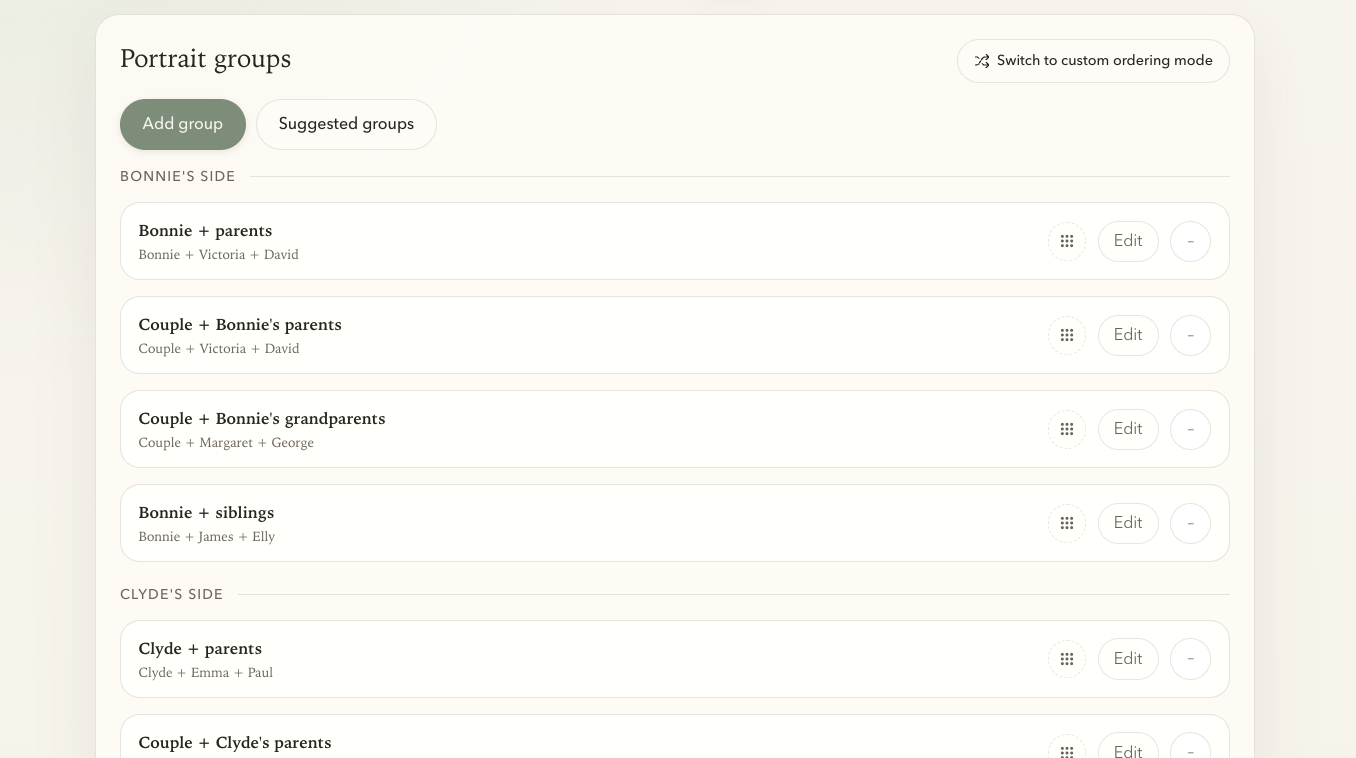
Imagine a list containing both families together, four combinations for one side, four for the other, and one grandparents group. The raw photographing allowance might total twenty-four minutes. Add five minutes to gather everyone at the start, three minutes to switch family sides, and five minutes of contingency for a missing relative or unsettled child. The realistic timeline allocation becomes thirty-seven minutes.
That does not mean every wedding needs a forty-minute block. A prepared group beside the ceremony location may move faster. A receiving line, long walk, drinks service or inaccessible portrait location may move much slower. The value of the model is that it makes hidden time visible before the couple decides how many groups are essential.
What makes family photographs run late
Most delays are predictable. They come from the system around the photographs rather than camera settings.
- The list uses relationships rather than names, so nobody knows exactly who is required.
- Guests leave for drinks, toilets or check-in before the groups begin.
- No family helper has been appointed to assemble the next group.
- The portrait location is far from the ceremony exit or has limited space.
- Separated relatives or accessibility needs were not discussed beforehand.
- Guests add combinations faster than completed groups leave.
- The official start time ignores confetti, congratulations or the receiving line.
- The largest group is attempted last, after people have dispersed.
Fixing even two of these usually saves more time than directing each group thirty seconds faster.
How to reduce the time without rushing people
Reduce duplication first. Couples often request the same people with and without one peripheral person, then another near-identical variation. Ask which image they would print or consider missing. Keep essential parent, sibling, grandparent and chosen-family combinations, then move informal friend requests into the reception when appropriate.
Sequence by subtraction, brief the helpers, and tell the people involved where to be and when. Start promptly rather than waiting for a perfect social pause. Keep your directions positive and specific: where to stand, where to look, what to do with hands, and when they are finished. Confident direction feels calmer than repeated apologies about speed.
Protect a small buffer. If you allocate every minute, a missing grandparent forces a choice between abandoning the photograph and stealing time from couple portraits. A five-minute buffer is not wasted when everything runs well; it becomes breathing room or an extra candid moment.
Place family photographs correctly in the timeline
The best slot depends on light, location, family availability and the couple’s priorities. Immediately after the ceremony can work because people are gathered, but congratulations and confetti make the true start later than the ceremony end. Before the ceremony can reduce pressure when a first look and the necessary family attendance are already planned. During the reception may be practical for a small number of friend groups but unreliable for a long formal list.
Write gathering and movement into the schedule. ‘Family photographs 14:30–15:00’ is incomplete if the ceremony ends at 14:30 and the portrait location is a seven-minute walk away. The plan should state who moves people, where the first group assembles, and what happens in bad weather.
Build your own timing profile
After each wedding, compare the planned and actual family-photo block. Note the number and size of groups, location, helper quality, delays and whether you felt rushed. After ten weddings, you will have a more defensible starting point than any internet rule.
Use that evidence in client conversations. Instead of saying a list is ‘too long’, explain that their twelve groups are likely to require thirty-five minutes under the current conditions and show what that means for the drinks reception or couple portraits. Clear trade-offs make the couple part of the decision and protect the photography experience.
Adjust the estimate for real wedding scenarios
A church ceremony followed by photographs at the altar needs a different allowance from an outdoor ceremony where guests walk directly into a drinks reception. At the church, access may be controlled and the next service may impose a hard deadline. Outdoors, light and space may be better but guests disperse quickly. Add or remove buffer because of the actual environment, not because one setting appears simpler.
Large cultural weddings may include family structures and group expectations that do not fit a ten-item template. Separate ceremonial groups from reception-stage photographs, identify who announces names, and ask whether a photograph is formal portraiture or documentation of a ritual. A whole-party photograph can be efficient when it is stage-managed before guests scatter; attempted spontaneously, gathering can dominate the schedule.
Weather changes both location and movement. A wet-weather room may be smaller, darker and farther from the ceremony exit. Test the largest group there before committing to the same estimate. At destination weddings, allow for guests navigating an unfamiliar venue and for communication across languages. The principle stays constant: photograph time, gather time, movement and contingency are separate quantities.