Choose the sending window deliberately
There is a tension between certainty and preparation time. Send the form months too early and the couple will enter placeholder times, missing supplier details and locations that later change. Send it a week before the wedding and every gap becomes urgent. For a conventional wedding, four to eight weeks is a sensible starting range.
Adjust for complexity. Multi-day celebrations, destination travel, ceremonies with restrictions, several locations or unusually large families may need an earlier first pass. That does not mean collecting every final answer earlier; it means identifying risk early and confirming volatile details closer to the date.
Explain why completion matters
Do not send a bare link with ‘please complete this’. Tell the couple that you will use their answers to prepare the group photographs, confirm the photography timeline and understand practical or sensitive details before the day. Give a completion date and an honest estimate of the time required.
Make the message sound like service, not compliance. The couple has already completed many supplier forms. Explain the result they will receive: fewer repeated questions, a reviewed plan and more confidence that the right people and moments are accounted for.
Remove avoidable completion friction
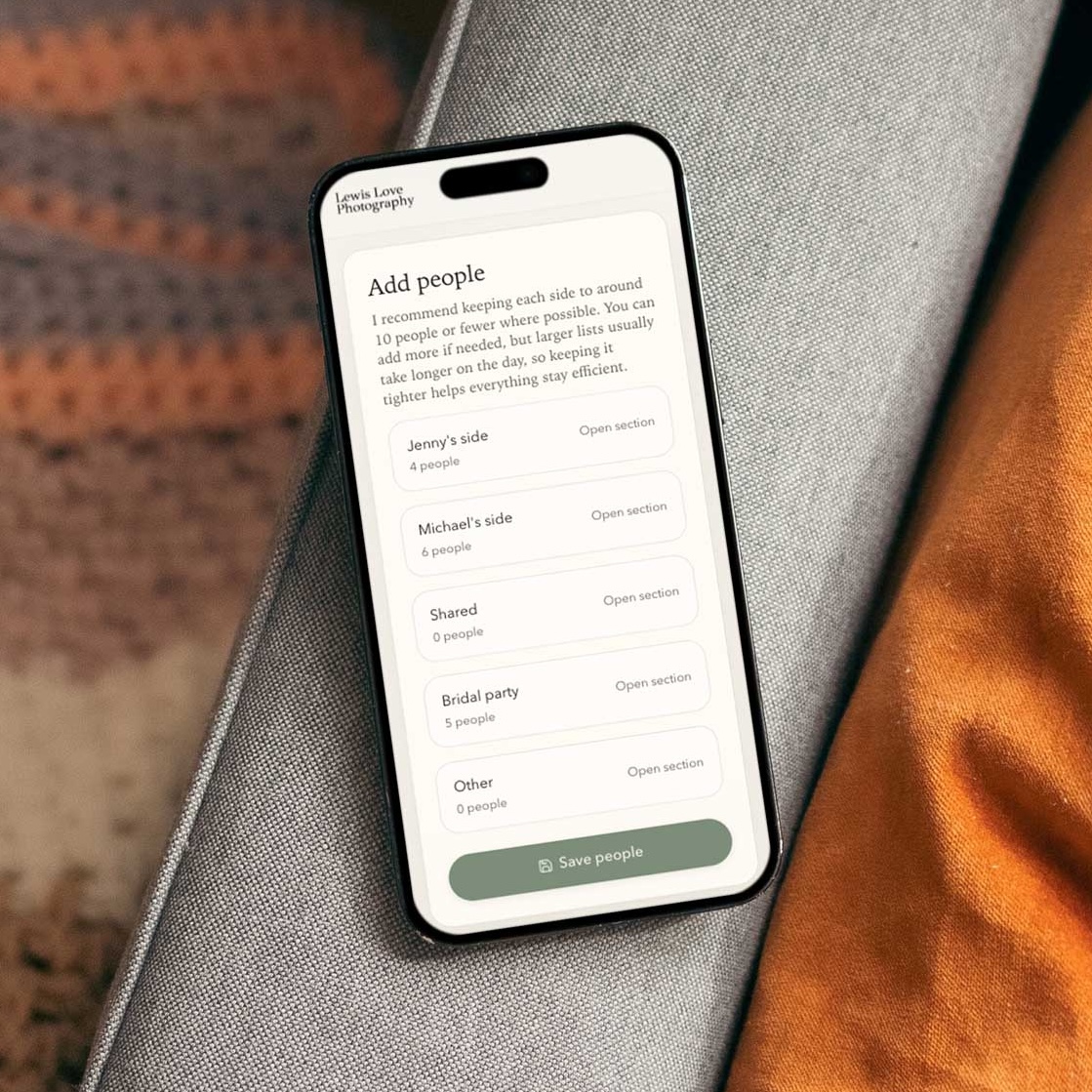
Let couples open a private link without creating another account. Design for phones, use short sections, and allow progress to be saved. Pre-fill facts you already know or phrase them as confirmations. Use conditional fields so irrelevant questions disappear.
Ask one thing per question. ‘Tell me the ceremony time, address, parking and restrictions’ looks efficient but produces partial answers that are hard to validate. Separate fields also make it easier to transfer information into a timeline or location plan. Give examples where formatting matters, especially for named family groups.
Use a simple reminder sequence
One reminder a few days before the deadline is usually enough. After the deadline, send a personal follow-up that names the decisions waiting on the questionnaire. If the planning call depends on it, state that you need the answers before the call can be productive.
Avoid escalating through a stream of automated reminders. If a couple is stuck, ask whether there is a section they cannot answer. They may be waiting on a venue schedule or avoiding a difficult family question. A short conversation can resolve the blocker faster than another generic email.
Know which answers become stale
Treat these details as volatile and reconfirm them during the final review:
- Preparation addresses, access instructions and parking.
- Hair and makeup completion times.
- Ceremony duration, confetti and receiving-line plans.
- Meal, speeches, cake and first-dance times.
- Family attendance and requested group combinations.
- Planner, venue and day-of contact details.
- Travel arrangements and supplier restrictions.
Do not ask the couple to submit the entire form again for one change. Keep a visible updated-at date and record amendments in the same master plan.
Review before the planning call
Read the completed questionnaire once for the shape of the day and again for contradictions. Compare it with the booking, venue information and existing schedule. Highlight questions that require a decision, not merely more detail. Estimate the requested family groups and check coverage boundaries.
Use the call to agree exceptions and trade-offs. Afterwards, send a concise summary, update the master timeline and group order, and tell the couple what happens next. A submitted questionnaire is raw material; a reviewed photography plan is the service.
A completion email you can adapt
Keep the delivery message concise: ‘Your final photography questionnaire is ready. Please complete it by [date], before our planning call on [date]. I’ll use your answers to confirm the photography timeline, organise the family group list and prepare for any practical or sensitive details. It usually takes around [your tested estimate] and works on a phone. You can return to the same private link if you need to check something before submitting.’
Then add one sentence specific to the wedding. Mention that you already know the ceremony venue, or that you particularly need the confirmed reception schedule. Personal context signals that this is part of their service rather than an automated form sent to everyone. Close with a clear route for questions if a section is difficult to answer.
After submission, acknowledge receipt and set the next expectation. Tell them when you will review it, whether they need to do anything before the call, and how later corrections should be sent. Couples are more likely to trust the process when completion visibly moves the planning forward.
What not to ask in the final questionnaire
Do not use the final form to repeat discovery questions that were important before booking but no longer alter the service. Avoid demanding inspiration boards, exhaustive lists of standard moments you already photograph, or intimate relationship stories without a clear purpose. Long open-text prompts create work for the couple and unstructured reading for you.
Avoid collecting sensitive personal information merely because it might be useful. Ask for the minimum practical context and explain why. Do not ask the couple to choose technical coverage decisions they hired you to make. They should communicate priorities and constraints; you should turn those into photographic decisions.
Finally, do not make submission equal automatic approval. The answers may contain an impossible group list, conflicting times or a request outside the booked coverage. Preserve a review step and communicate changes before locking the plan.